The best roller coaster seat is not a fixed position on the train. It depends on whether you care most about an unobstructed view, the feeling of being pulled into a drop, moments of weightlessness or the way a particular ride moves.
The differences are measurable. In 2012, physics student Kelsey Lubetich studied acceleration on California Screamin’ at Disney California Adventure. Using negative vertical acceleration as one measure of the best experience, the investigation identified the front row as the strongest position on that particular coaster.
That finding challenges the familiar claim that the back row always delivers the greatest airtime. To understand why, it helps to consider how an entire train moves over the track.
Why the same drop feels different from each row
A roller coaster train moves as a connected vehicle. When the leading car reaches the crest of a lift hill, the rest of the train may still be climbing. The front passengers can appear to hang over the drop while waiting for more of the train to pass the summit.
By the time the final car reaches that point, much of the train may already be descending. Passengers at the rear can experience a more pronounced pulling sensation as their car is carried over the crest.
This does not mean the back has a permanently higher speed than the front. Rather, different rows reach the same track element at different moments in the train’s acceleration cycle.
The pattern also changes from hill to hill. On some airtime crests, the front can provide stronger negative acceleration. On others, the rear produces the more noticeable lifting sensation.
Front row: visibility becomes part of the thrill
The strongest argument for the front seat is the view. With no other cars immediately ahead, riders can follow the track directly into hills, curves and inversions.
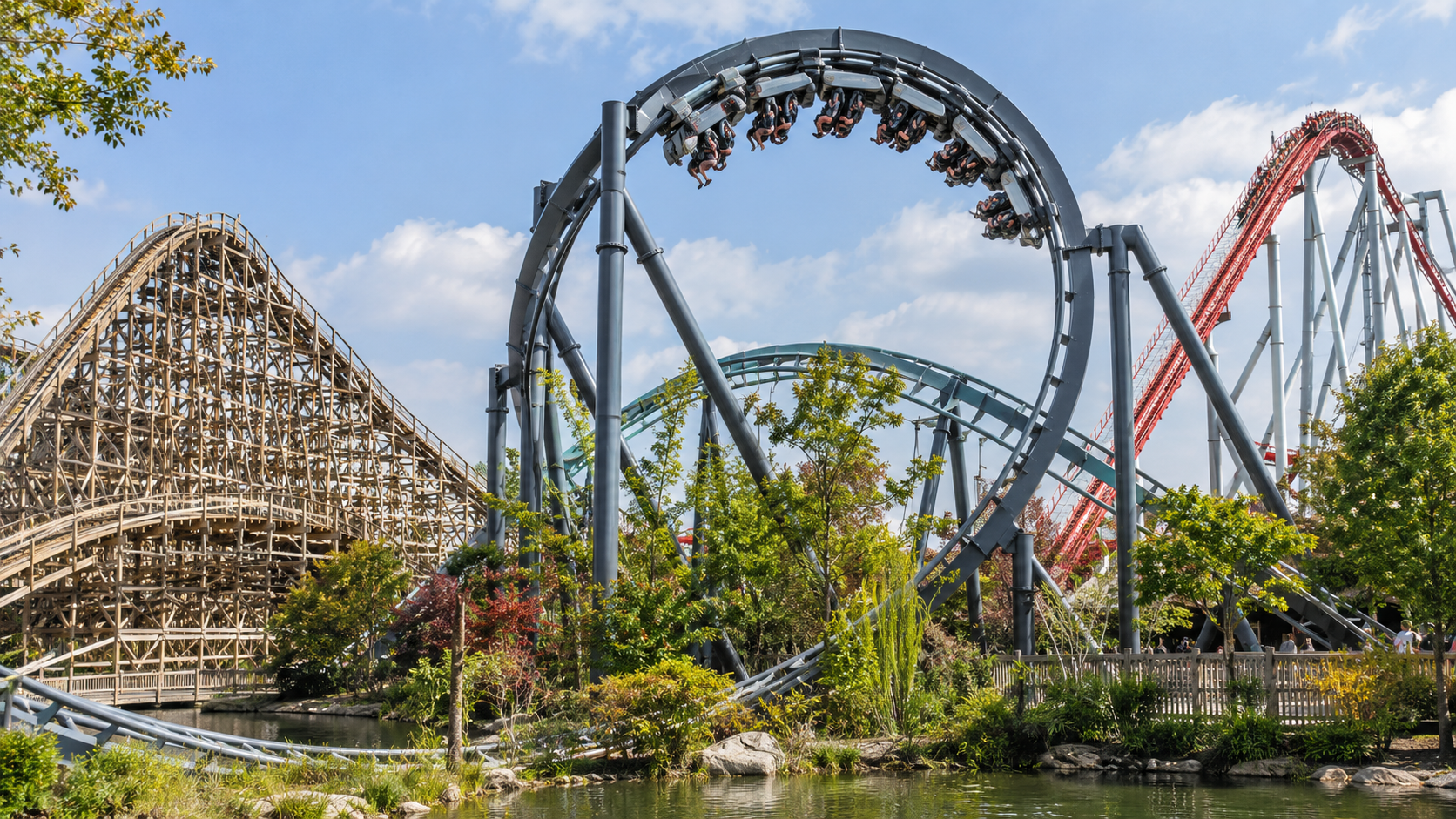
That matters especially on inverted roller coasters, where the train runs below the track and riders’ legs hang freely. Kings Island’s official coaster terminology guide identifies this design as distinct from a suspended coaster, whose cars can pivot.
At the front of an inverted coaster, the landscape and approaching elements are easier to see. Further back, the train itself becomes part of the visual experience.
An unobstructed view is not automatically more comfortable. Watching a steep drop approach may heighten anticipation, even when the physical forces are not unusually strong.
Back row: a different way to experience gravity
For enthusiasts who particularly enjoy the pull into a first drop, the back row is worth considering.
This preference is especially relevant on traditional coasters with long trains, major hills and repeated transitions between climbing and descending. It can also change the timing of airtime, the moment when riders feel unusually light against their restraints.
However, no seat ranking applies to every wooden or steel coaster. A ride’s track geometry and train length matter more than a simple classification by construction material.
The middle offers another choice. Its movement more closely represents that of the train as a whole, although it is not guaranteed to deliver the lowest forces everywhere. In an interview with BBC Science Focus, thrill engineer Brendan Walker described the centre as a useful reference for riders less familiar with large roller coasters.
Different coaster designs, different priorities
Airtime-focused coasters
When a ride features repeated hills, choosing between the front and rear can meaningfully change the experience. Europa-Park’s WODAN in Germany is a wooden coaster whose official description highlights multiple airtime sections.
Its design makes seat comparison interesting, but it would be misleading to declare one row universally superior without measurements across the specific track elements.
Launched and looping coasters
A launch does not automatically make the front seat the most powerful. What happens after the acceleration matters just as much.
At Liseberg in Sweden, researchers recorded acceleration data from rows 2, 6 and 9 of Helix on May 3, 2014. Their findings show different force patterns during airtime hills and inversions. Some elements produced stronger effects near the ends of the train, while others affected the front and rear differently.
The study demonstrates why the familiar front-versus-back debate cannot be settled by a single rule.
Wing coasters
On some designs, lateral seat placement introduces another dimension. Intamin’s Wing Coaster concept includes positions that produce different sensations depending on whether passengers sit on the inner or outer part of the train.
For riders choosing between these seats, being beside the track rather than closer to its centre can matter as much as being at the front or back. The precise effect depends on the vehicle and layout.
Intamin lists Skyrush at Hersheypark in Pennsylvania and Flying Aces at Ferrari World Abu Dhabi among its wing coaster references, illustrating how this seating concept appears in different markets.
Dive and spinning coasters
On a dive coaster such as Baron 1898 at Efteling in the Netherlands, seeing the plunge ahead can be a major part of the experience. Its official ride description identifies a 37.5-metre descent. A seat with a clearer forward view may therefore appeal to riders who enjoy the visual drama of a drop.
Spinning coasters complicate the question further. Manufacturer Mack Rides describes freely rotating gondolas and different possible seating orientations. Because the gondola can change direction during the ride, a familiar front-to-back ranking becomes less useful.
A practical seat-selection strategy
Choose the front if seeing the track is your priority. Try the rear if you want to explore the pulling sensation associated with major drops. Consider the middle for a more central reference point on a long train, without assuming it will always be gentle.
For wing or spinning designs, pay attention to seat orientation and lateral positioning instead. Follow the ride operators’ seating instructions, since individual seat requests are not always possible.
Most importantly, comparing two different rows on the same attraction reveals something that a universal ranking cannot: your favourite place depends on the interaction between the coaster’s engineering and the sensations you personally enjoy.