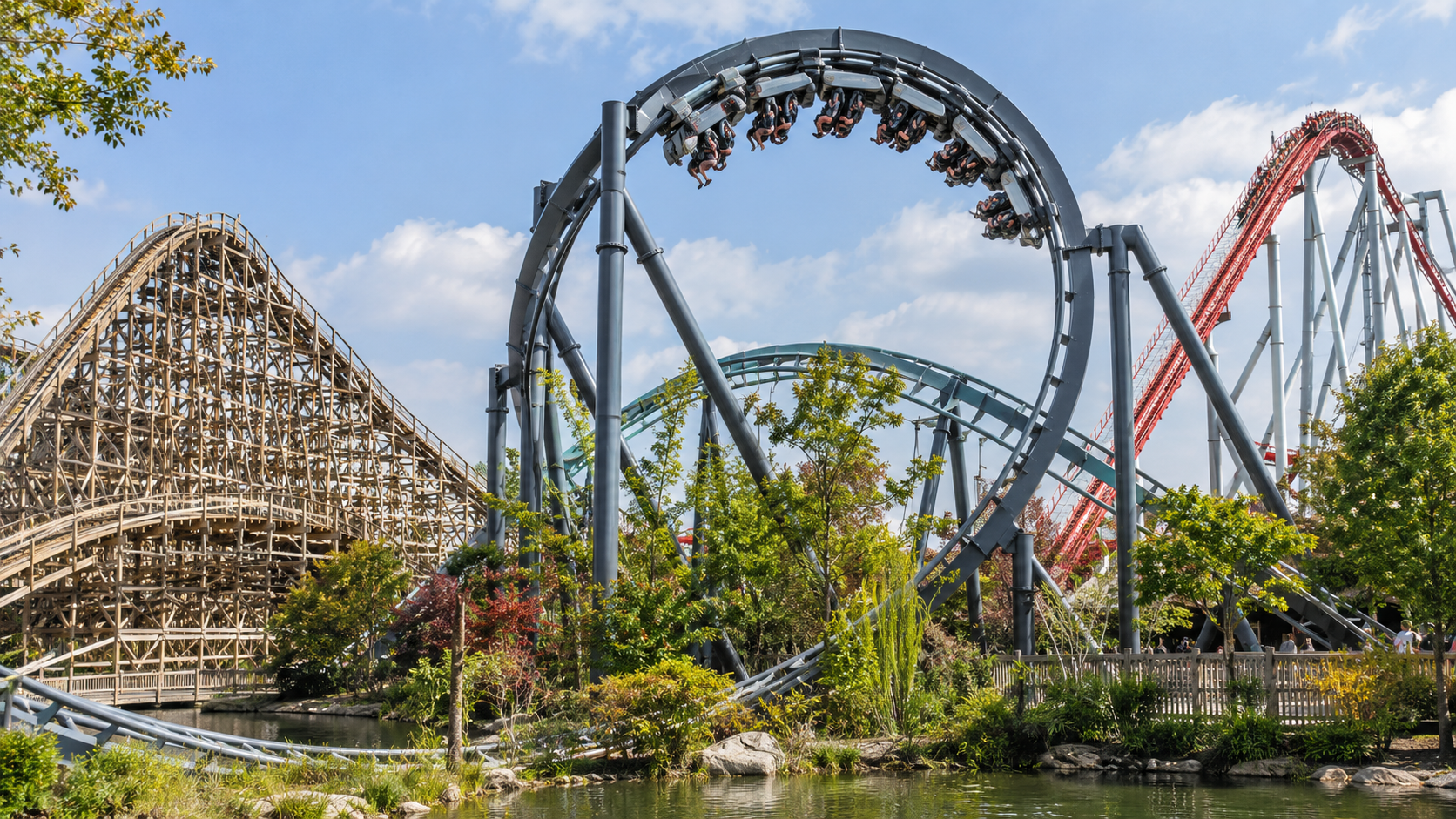
A roller coaster can be described as wooden, launched, spinning and inverted. Those labels do not all answer the same question. Some identify the track, others describe how riders sit, how a train accelerates or what happens along the route. Several labels can apply to one ride, so learning the basic categories is more useful than memorising a single list.
Start with the track, not the support structure
The oldest familiar distinction is between wooden and steel roller coasters. In the Roller Coaster DataBase classification, a wooden coaster has a running track made from layers of wood; a steel coaster uses steel rails or tubes. The material supporting the track does not necessarily determine the classification.
That distinction matters when a coaster looks wooden from a distance. Rocky Mountain Construction’s I-Box track is made entirely of steel, although its supporting framework may be wooden. Rides built or rebuilt with this combination are often marketed as hybrid coasters. The word describes a design approach, not an extra category of rail material.
A traditional wooden ride is not automatically gentle, either. Germany’s WODAN - Timburcoaster at Europa-Park is a wooden coaster with a 1,050-metre route, banked turns and airtime hills. Those hills can produce moments of apparent weightlessness without turning riders upside down.
Where do the passengers sit?
The most familiar configuration is sit-down, with riders seated in a train running above the track. An inverted coaster places the vehicles beneath the rails, often leaving riders’ legs dangling. In technical classification, an inverted train is rigidly attached to the track. A suspended coaster, by contrast, uses hanging vehicles that can swing from side to side. The term “suspended” is also used more broadly in ride marketing, so product names do not always follow that strict distinction.
There are other ways to change perspective. A flying coaster places riders in a near-horizontal, face-down position during parts of the ride. On a wing coaster, seats sit to the sides of the track rather than directly above or below it. A floorless coaster removes the floor beneath seated passengers’ feet. Some designs use a standing position. These describe the relationship between the body and the track, not a guaranteed level of intensity.
How does the train gain speed?
Many rides begin with a lift hill that raises the train before gravity drives it through the course. A launched coaster uses propulsion to accelerate more directly. The launch can be repeated or combined with a traditional lift.
Japan offers a clear example in Zokkon at Fuji-Q Highland. Intamin describes a motorbike-style coaster with several magnetic launches, including a backwards one. Its motorbike seating and propulsion belong to different parts of the classification: one concerns the vehicle, the other how it moves.
A shuttle coaster also changes the expected pattern. Rather than completing a continuous circuit, the train reaches the end of its track and travels back the other way. Boomerang designs use this out-and-back principle. At Six Flags Mexico, Vekoma’s Speedway Stunt Coaster uses a family-oriented Boomerang Rebound design, showing that reverse travel need not mean an extreme attraction.
Spinning and Wild Mouse are not the same thing
A spinning coaster allows its cars to rotate around a vertical axis. That extra motion changes the view and the sense of direction. Mack Rides’ Time Traveler combines rotating cars with launches and inversions, illustrating how categories overlap. In Italy, the manufacturer’s Reversum uses free-spinning family cars without inversions. Spinning itself says little about how intense a ride will be.
A Wild Mouse is identified mainly by its compact cars and particularly tight, abrupt corners. A car can feel as though it is running past a bend before sharply changing direction. Some Wild Mouse rides also spin; others do not.
A dive coaster emphasises a steep, vertical or beyond-vertical drop. The terms hyper and giga tend to highlight large-scale designs built around height, speed and airtime. Those labels do not tell you whether a coaster launches, spins or uses an inverted seating arrangement.
Indoor rides and water coasters add another dimension
An indoor coaster uses an enclosed environment to control what riders see. Darkness, effects and scenery may become as important to the experience as the track itself. A water coaster brings coaster-like hills or turns into a ride with boats and water sections. Mack Rides’ launched water coaster concept combines powered acceleration with those aquatic elements.
These labels also remind us that a coaster is not defined solely by how tall or fast it is. A family ride might have a launch, a spinning car or a reversed section while remaining different from a high-intensity thrill coaster.
Choosing a ride that suits you
Read the description in layers: track material, riding position, launch or lift, inversions, spinning and layout. If you dislike being upside down, check for inversions rather than assuming every tall coaster includes them. If unexpected motion is uncomfortable, pay attention to spinning cars and launches.
Finally, check each park’s posted minimum heights, age limits and health restrictions. Europa-Park, for example, publishes attraction-specific requirements and information about test seats. The terminology helps you understand the design; the posted rules determine whether you can ride.